Practice Packs: The Better Way to Teach and Learn
Teaching works best when students know exactly what to practice.
Learning works best when the path is clear.
That is why Practice Packs matter.
A great lesson does not end when the teacher stops talking. It keeps working when the student goes home, opens the material, and knows exactly what to do next. The problem is that too many students leave a lesson with scattered notes, vague memory, and no clear system for repetition.
Practice Packs solve that problem.
They turn guided instruction into a repeatable plan.
The Problem With Traditional Practice Assignments
A lot of teaching still depends on loose follow-up.
A teacher explains a concept, demonstrates a section, maybe writes down a few notes, and expects the student to remember the rest. Even strong students can lose momentum once the lesson is over.
They may ask themselves:
What section was I supposed to repeat?
Where does the difficult part begin?
How many times should I go over this?
What did my teacher want me to focus on?
Was I supposed to slow this down first?
When the practice plan is unclear, progress slows down.
Students waste time trying to reconstruct the lesson instead of actually doing the work.
That creates frustration on both sides.
Teachers feel like students are not following through. Students feel like they are trying, but they are not sure what “correct practice” really looks like.
What a Practice Pack Actually Does
A Practice Pack gives structure to practice.
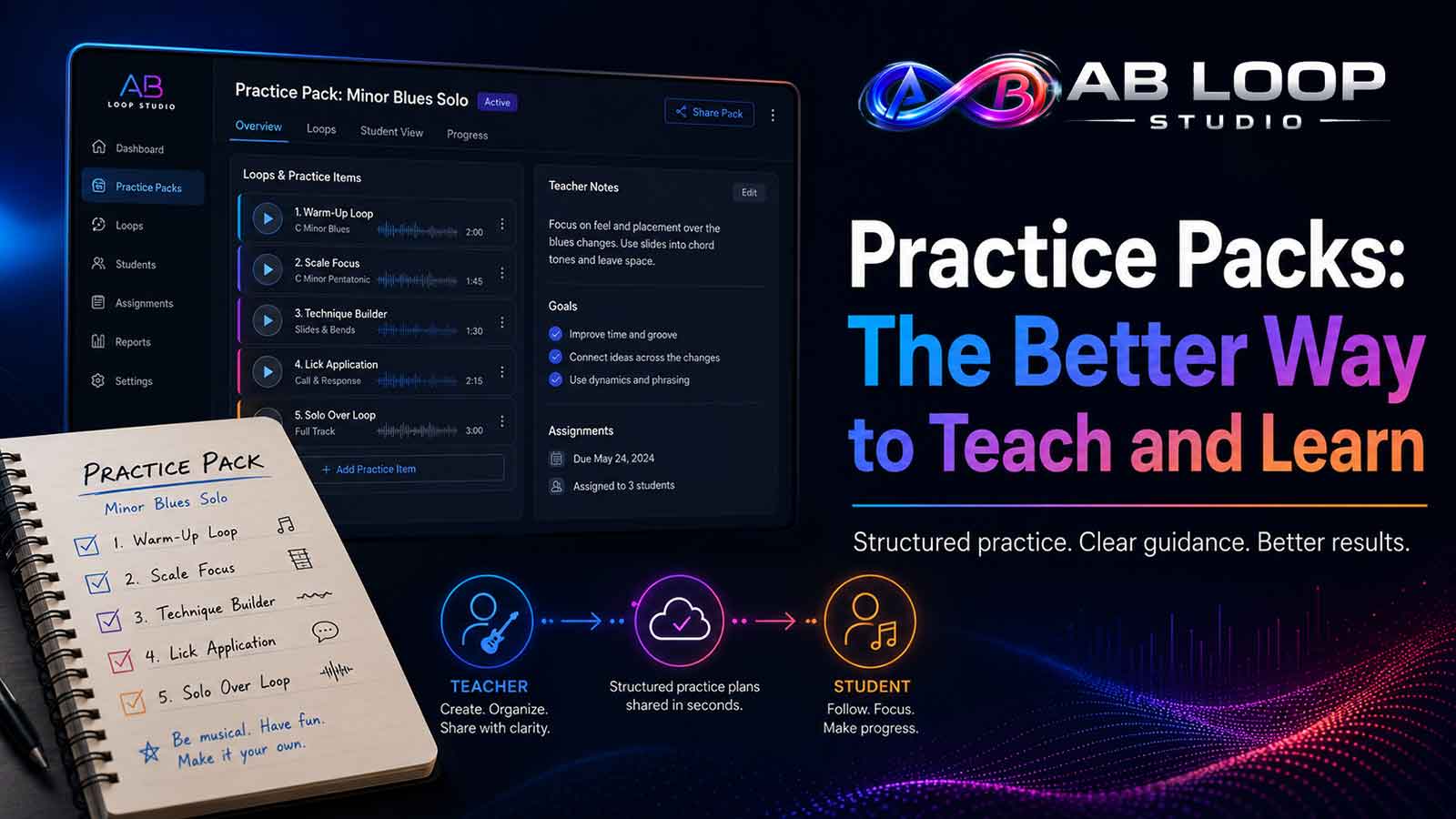
Instead of handing a student a vague assignment, the teacher can prepare a guided set of loops, notes, and focus points that tell the student exactly what to work on.
That means a Practice Pack can include things like:
Named sections to practice
Saved loop points
Practice order
Optional notes or reminders
Specific trouble spots
A clear sequence from easier work to harder work
Instead of saying, “Work on this before next week,” the teacher can say, “Start here, repeat this section, then move to the next one.”
That small change makes a huge difference.
Why Practice Packs Help Teachers Teach Better
Good teachers do more than present information.
They shape the learning process.
Practice Packs extend that process beyond the lesson itself. They let teachers package the actual method of practice, not just the concept being taught.
That is powerful because it improves consistency.
Every student gets the same guided structure. Every lesson has a clearer follow-through path. Every practice session starts with less confusion.
Teachers also benefit because Practice Packs reduce repetition in a different way. Instead of re-explaining the same assignment every week, they can create a more organized workflow that helps students stay on track between sessions.
In other words, the teaching continues even when the teacher is not in the room.
Why Practice Packs Help Students Learn Faster
Students improve faster when they can focus on the right things.
A Practice Pack removes guesswork.
The student does not have to remember where the difficult section starts. The loop is already there.
The student does not have to guess what matters most. The teacher’s notes guide the session.
The student does not have to spend ten minutes getting organized before they begin. The structure is already in place.
That means more time practicing and less time wandering.
It also builds confidence. When students know they are following the intended plan, they feel less overwhelmed. They can make progress one section at a time instead of feeling like the whole piece is a problem.
That is especially important for beginners, younger learners, and anyone who struggles with independent practice.
Practice Packs Make Repetition More Purposeful
Repetition is only useful when it has direction.
Practice Packs help define that direction.
A student can move through a sequence like this:
Warm up
Loop Section A
Repeat Section B slowly
Run the transition between A and B
Review teacher notes
Do one full run-through
That is much better than random repetition.
Purposeful repetition keeps practice focused, measurable, and easier to improve over time.
Instead of saying, “I practiced for a while,” the student can say, “I completed the assigned loops, worked through the sequence, and improved the weak transition.”
That is real progress.
Great for More Than Music
Practice Packs are a natural fit for music teachers, but the idea is bigger than music.
They can also help:
Language teachers assigning listening and repetition drills
Tutors breaking down lectures or study clips
Coaches highlighting specific movements or review segments
Content trainers sharing guided repetition steps
Creators teaching process-based skills in a structured way
Any time a teacher or coach wants someone to repeat the right section in the right order, Practice Packs can make that process clearer.
The principle is simple: structured practice leads to better learning.
Why Practice Packs Fit AB Loop Studio
AB Loop Studio is built around deliberate practice.
That means the goal is not just playback. The goal is repeatable improvement.
Practice Packs fit that mission perfectly because they turn A-B looping and guided review into a teachable system.
A teacher can prepare the important sections. A student can open the pack and practice immediately. The whole experience becomes more organized, more intentional, and more effective.
Instead of relying on memory, students get a built-in roadmap.
Instead of assigning “go practice,” teachers can assign a real plan.
That is the difference between hoping practice happens and designing it to happen.
The Better Way to Teach and Learn
The best teaching does not stop at explanation.
The best learning does not depend on guesswork.
Practice Packs help bridge the gap between lesson and follow-through. They give teachers a better way to guide. They give students a better way to practice. And they make repetition more focused, useful, and intentional.
That is why Practice Packs are not just a feature.
They are a better way to teach and learn.